Czech for Travel: 30 Phrases That Make Your First Days in Prague Easier
You do not need perfect Czech to order lunch, find the platform or politely say that you do not understand. You need the right thirty phrases, in the right order, and the confidence to say them first.
Most Czech phrase lists give you a hundred words and no context. This guide is different. It follows your first 72 hours in Prague: arrival, transport, food, payment, directions and help. Each phrase comes with simple pronunciation and a note on when Czechs actually use it.
Before you start: two rules for pronunciation
Czech is more honest than English. Words are pronounced as they are written. Two rules will carry you a long way.
First, stress always falls on the first syllable. In the guides below, the stressed syllable is in capitals.
Second, a long mark lengthens the vowel. Á, é, í and ú/ů are held longer, not stressed. Dobrý is "DOH-bree", with a long "ee" at the end.
Then there is ř, the sound every visitor hears about. It is a unique sound that only found in Czech and the hardest to pronounce correctly. Think of a rolled r and "zh" said at once. Do not panic if it comes out as "rzh". You will be understood. Our guide to Czech pronunciation for English speakers covers it properly.
Hour one: arrival and first contact
These eight phrases do most of the social work. Learn them during your travel to the czech republic (you won’t need your flight delayed).
Dobrý den. (DOH-bree den) — Hello. Good day.
Na shledanou. (NAH-skhleh-dah-noh) — Goodbye.
Prosím. (PROH-seem) — Please. Also "here you are" and "pardon?"
Děkuji. (DYEH-koo-yee) — Thank you.
Promiňte. (PROH-miny-teh) — Excuse me. Sorry.
Mluvíte anglicky? (MLOO-vee-teh AHN-glits-kee) — Do you speak English?
Nerozumím. (NEH-roh-zoo-meem) — I do not understand.
Můžete mluvit pomaleji? (MOO-zheh-teh MLOO-vit POH-mah-leh-yee) — Could you speak more slowly?
The cultural point matters more than the vocabulary. Czechs greet the room. You say dobrý den when you enter a small shop, a pharmacy, a waiting room, even a lift with neighbours. You say na shledanou when you leave. Skipping it does not feel neutral here. It feels cold.
Notice, too, that every phrase in this guide uses the formal vy form. With strangers, staff and officials, formal is correct. Nobody will mind you being polite. (if you know a little bit of czech already, do your best to avoid ty forms until someone offers to use ty).
One more detail. Ask Mluvíte anglicky? only after dobrý den. Opening with Czech, then switching, signals respect. It often earns a warmer answer.
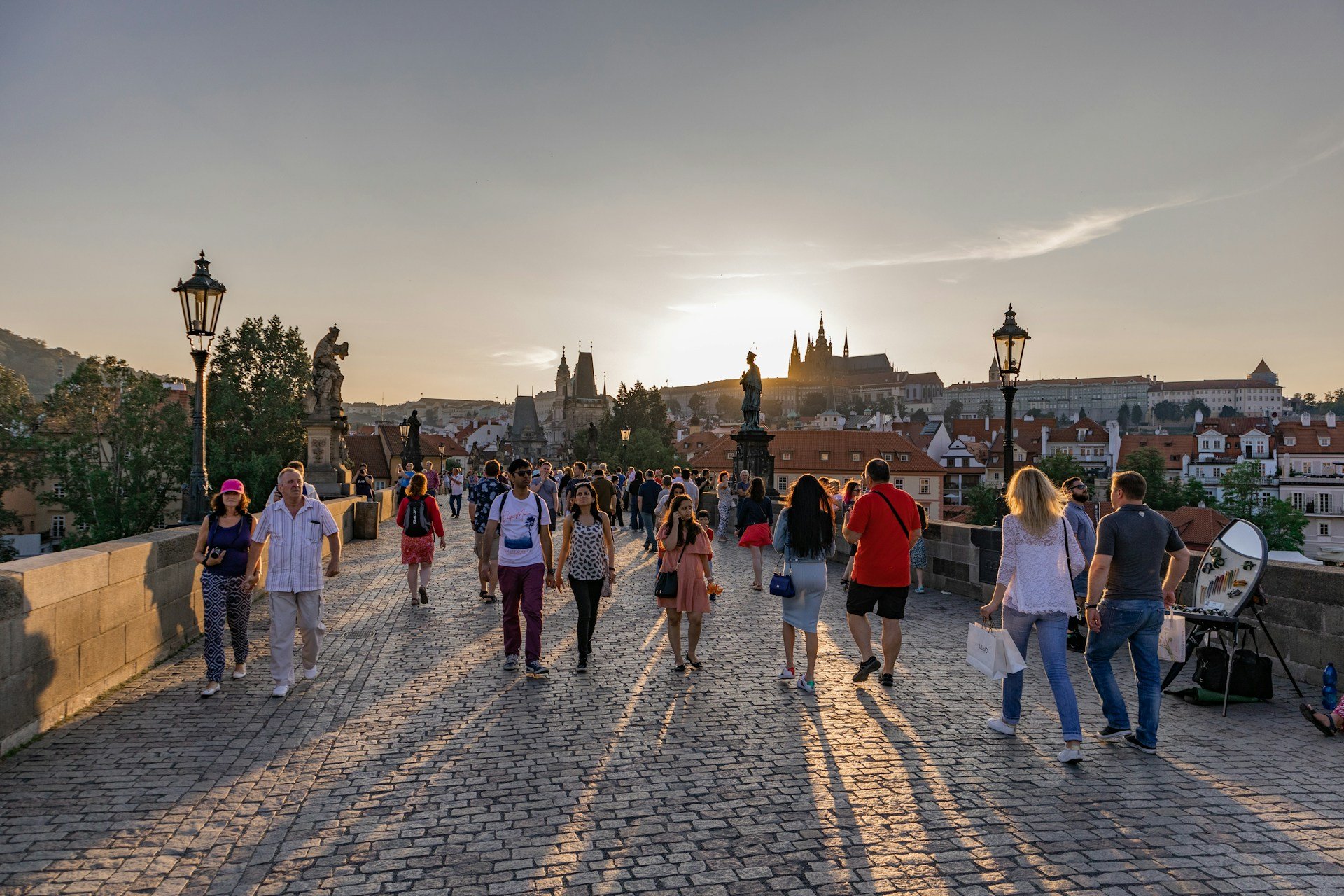
Image by Denis Vdovin
Hours one to three: getting into the city
Prague's airport has no metro. Most people take trolleybus 59 to Nádraží Veleslavín and change to metro line A, as Prague Airport recommends. The Airport Express (AE) goes to the main railway station, but it has its own fare of CZK 200 and standard tickets are not valid on it, according to the Prague Public Transit Company. (you can pay with card so do not worry about having cash before you arrive).
A standard 90-minute ticket costs CZK 50 on paper or CZK 46 in the PID Lítačka app, and covers metro, trams and buses with free transfers (PID). A paper ticket must be stamped once in a yellow validator on your first ride. App tickets need activating before you board (PID). Inspectors do check.
Jednu jízdenku na devadesát minut, prosím. (YED-noo YEEZ-den-koo nah DEH-vah-deh-saat MI-noot) — One 90-minute ticket, please.
Kde je zastávka? (GDEH yeh ZAHS-taav-kah) — Where is the stop?
Jede to do centra? (YEH-deh toh doh TSEN-trah) — Does this go to the centre?
Z kterého nástupiště to jede? (SKTEH-reh-hoh NAAS-too-pish-tyeh toh YEH-deh) — Which platform does it leave from?
Vystupujete? (VIS-too-poo-yeh-teh) — Are you getting off?
Příští zastávka… (PRZHEESH-tyee ZAHS-taav-kah) — Next stop…
Two of these need context.
Vystupujete? is the most useful tram phrase in Prague. When the tram is full and you need to reach the door, you do not push. You ask the person in front if they are getting off. If they say ne, they will step aside.
Příští zastávka is a phrase to hear, not say. Every tram and metro announces the next stop this way. In the metro, you will also hear Ukončete, prosím, výstup a nástup, dveře se zavírají: "Please finish getting on and off, the doors are closing." Step back.
At train stations, departure boards show both nástupiště (platform) and kolej (track). Find the platform first, then the track number on the sign.
Hours three to twenty-four: food and cafés
Lunch is where your first real Czech conversation usually happens.
Je tu volno? (YEH too VOL-noh) — Is this seat free?
Máte stůl pro dva? (MAA-teh stool proh dvah) — Do you have a table for two?
Jídelní lístek, prosím. (YEE-del-nyee LEES-tek PROH-seem) — The menu, please.
Dám si… (DAAM see) — I will have…
Je to bez masa? (YEH toh BEZ MAH-sah) — Is it without meat?
Zaplatím, prosím. (ZAH-plah-teem PROH-seem) — I would like to pay, please.
Je tu volno? belongs in a busy pub or beer garden, where sharing a table is normal. Point to the empty chair, ask, and sit when you hear jo or ano.
Dám si is the key ordering structure. Add any word after it: dám si kávu, dám si polévku, dám si jedno pivo. One pattern, a hundred uses.
On weekdays, look for the polední menu: a set lunch, often soup and a main, served at local prices. It is where office workers eat. It is also where you will hear the most everyday Czech.
When you want the bill, say zaplatím. In many Czech restaurants, the waiter will not bring it until you ask.
Payment: the moment people freeze
Cards are widely accepted across Czechia, as VisitCzechia confirms. The language around payment is still where visitors hesitate.
Kolik to stojí? (KOH-lik toh STOH-yee) — How much is it?
Můžu platit kartou? (MOO-zhoo PLAH-tyit KAR-toh) — Can I pay by card?
Dohromady, nebo zvlášť? (DOH-hroh-mah-dee, NEH-boh zvlaasht) — Together or separately?
Udělejte to…, prosím. (OO-dyeh-lay-teh toh… PROH-seem) — Make it…, please.
Expect to hear phrase 23 when there are two or more of you. The waiter is asking whether to split the bill. Answer with one word: dohromady or zvlášť.
Phrase 24 is how Czechs tip. Customary tips are up to 10%, according to VisitCzechia. You do not leave coins on the table. You say the total you want to pay. If the bill is 320 crowns, say Udělejte to tři sta padesát (make it 350). Calm, quick and local. This may be the most difficult part for beginners to understand numbers said quickly. don’t worry about asking for the number again (jěstě jednou prosím) so you can confirm the number and the tip.
Getting around on foot
Prague's centre is compact, but the streets curve. These phrases get you unstuck.
Jak se dostanu na…? (YAHK seh DOS-tah-noo nah) — How do I get to…?
Je to daleko? (YEH toh DAH-leh-koh) — Is it far?
Doleva, doprava, rovně. (DOH-leh-vah, DOH-prah-vah, ROV-nyeh) — Left, right, straight on.
Kde jsou toalety? (GDEH soh TOH-ah-leh-tee) — Where are the toilets?
Phrase 27 is for listening. When you ask the way, the answer will come fast. You do not need every word. Listen for doleva, doprava and rovně, and watch the hands.
Public toilets often carry a small fee. Signs may read WC, muži (men) and ženy (women).
When you need help
You will probably not need these. Learn them anyway.
Můžete mi pomoct? (MOO-zheh-teh mee POH-motst) — Can you help me?
Potřebuji lékaře. (POT-rzheh-boo-yee LEH-kah-rzheh) — I need a doctor.
For a pharmacy, use the pattern you already know: Kde je lékárna? (Where is the pharmacy?). In an emergency, call 112. It is free, and its operators can handle calls in foreign languages, according to the Ministry of the Interior.
If you are moving here rather than visiting, your next high-stakes conversations will happen at an office counter. Our Czech Bureaucracy Survival Guide prepares you for that first town hall appointment.
How to use these phrases in 72 hours
Do not try to learn all thirty at once. Follow the order of your trip.
Before you fly: phrases 1 to 8. Say them aloud until they feel ordinary.
Day one: add transport (9 to 14). Use dobrý den and děkuji with every person you meet.
Day two: add food and payment (15 to 24). Order one full meal in Czech, from dobrý den to zaplatím.
Day three: add directions and help (25 to 30). Ask one stranger the way, even if you know it.
The goal is not perfection. It is the moment you speak first. Most Czechs will meet that effort with patience. Some will switch to English. Answer in Czech once more before you switch.
For more ways to keep Czech around you after the trip, read our guide to practical ways to immerse yourself in Czech.
From survival phrases to real confidence
Thirty phrases will get you through your first days. They will not yet carry a conversation with a landlord, a colleague or your partner's family. That takes guided practice, correction and someone who knows how Czech is really spoken in Prague.
At Czech Atelier, we start from the situations you will actually face. A short 20-minute conversation lesson is enough to rehearse your arrival. Individual lessons build the grammar behind these phrases, so you can make your own.
Related articles